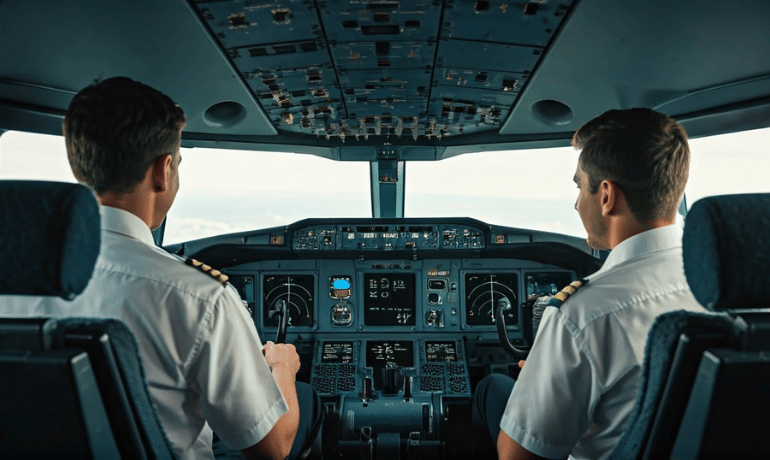
The dream of sitting in a glass cockpit, overlooking a sea of clouds at 35,000 feet, is a calling that many feel but only the persistent pursue. If you have ever watched a jet streak across the sky and wondered what it takes to be at the controls, you are in the right place. Choosing a commercial pilot course is the first definitive step toward turning that curiosity into a career.
In India, the aviation sector is currently witnessing a historic expansion. With hundreds of new aircraft being ordered by domestic carriers, the demand for skilled aviators has never been higher. However, the path is rigorous, requiring a blend of academic precision, physical fitness, and mental resilience.
Who is a Commercial Pilot?
A Commercial Pilot is a professional licensed by the Directorate General of Civil Aviation (DGCA) to fly aircraft for remuneration. Unlike a private pilot, who flies for leisure, a commercial pilot is responsible for the safety of hundreds of passengers or valuable cargo. This role demands a high level of technical expertise, leadership, and the ability to make split-second decisions under pressure.
Steps to Become a Commercial Pilot in India
Navigating the transition from a student to an aviator involves a series of highly regulated phases. Here is your comprehensive roadmap.
1. Meet the Eligibility for Commercial Pilot in India
Before you look for flying schools in India, you must ensure you meet the legal and physical prerequisites.
a) Age Requirement: You can start your ground school at 16 and begin flying at 17. However, to be issued a pilot license (CPL), you must be at least 18 years old.
b) Educational Qualification: You must have passed 10+2 with Physics and Mathematics. If you were an Arts or Commerce student, don’t lose heart, you can clear these subjects through the National Institute of Open Schooling (NIOS) to meet the requirements.
c) Physical Requirements: Good eyesight (corrected to 6/6) and general physical health are vital. There is no specific height requirement, provided you can reach all flight controls comfortably.
d) Medical Fitness: This is a two-stage process. You begin with a Class 2 medical exam by a DGCA-empanelled doctor, which is later upgraded to a Class 1 medical.
2. Enrol in a Flying School
Selecting the right aviation training institute is perhaps the most critical decision you will make. This choice dictates the quality of your skills and the speed of your progression.
Things to Consider When Choosing a Flight School
Look beyond the shiny brochures. Check the aircraft-to-student ratio, the availability of flight instructors, and the school’s track record with the DGCA. OpenSky emphasizes a balanced approach, ensuring students aren't just "logging hours" but are actually gaining the proficiency needed for airline operations.
Typically, a full-time commercial pilot course takes between 18 to 24 months. This depends heavily on weather conditions, aircraft maintenance, and your own consistency in clearing exams.
3. Generate Computer Number
Think of the Computer Number as your "Aviation Aadhaar." It is a unique identification number issued by the DGCA via the eGCA portal. You cannot sit for any pilot exams without this. The process involves verifying your educational board marks and identity documents.
4. Complete Ground School Training
Many students rush to the cockpit, but the "flying" starts in the classroom. You must pass five main DGCA theory papers:
- Air Regulations
- Air Navigation
- Aviation Meteorology
- Technical General (Aircraft & Engines)
- Technical Specific (for a particular aircraft type)
Additionally, you must clear the Radio Telephony Restricted (Aero) or RTR(A) exam, which focuses on your communication skills with Air Traffic Control.
5. Accumulate Flying Hours
To qualify for your pilot license, you need to log a minimum of 200 hours of flying time. This isn't just generic flying; it’s a specific mix:
- 100 hours as Pilot-in-Command (PIC).
- 20 hours of Cross-Country flying.
- 10 hours of Instrument Flying (flying solely by looking at your cockpit dials).
- 5 hours of Night Flying.
6. Class 1 Medical Fitness
While a Class 2 medical gets you started, a Class 1 medical is the gold standard required to hold a CPL. These exams are conducted at specialized Air Force Medical Centers or certified private hospitals and are much more stringent, covering everything from cardiac health to neurological stability.
7. Passing the DGCA Exams
The exams are held quarterly. You need a minimum of 70% to pass each subject. Given the technical nature of these papers, many students opt for a structured commercial pilot course at a specialized aviation training institute like OpenSky to ensure they have the conceptual clarity needed to ace them.
8. Obtain Your Commercial Pilot License (CPL)
Once you have your 200 hours logged and all your theory papers cleared, you submit your "License Folder" to the DGCA. After a thorough audit of your flying records and results, you are issued your CPL, your ticket to a professional cockpit.
9. Type Rating and Airline Training
Holding a CPL allows you to fly smaller aircraft, but to fly a Boeing 737 or an Airbus A320 for an airline, you need a Type Rating. This is an intensive 45-60 day course focusing on the systems and handling of a specific commercial jet.
10. Begin Your Career as a Commercial Pilot
With your CPL and Type Rating in hand, you are ready for airline inductions. You will start as a Junior First Officer, eventually progressing to First Officer and, finally, Captain.
To Wrap Up
Becoming a pilot is a marathon, not a sprint. It requires financial planning, academic dedication, and a genuine love for the skies. While the pilot training cost in India can seem daunting, the return on investment, both financially and in terms of career satisfaction, is unparalleled.
By choosing a structured commercial pilot course and the right mentors, you can navigate the turbulence of exams and medicals with confidence. At OpenSky, we are committed to simplifying this journey, providing the ground training and guidance you need to earn your wings.